Policy
World-action model that proposes executable action chunks.

Motus2
Motus2 is a self-evolving General World Model for dexterous manipulation, advanced through model scaling and data scaling. A single shared-parameter model exposes a policy, a simulator, and an evaluator, coupling action proposal, consequence prediction, and outcome evaluation into a closed decision-and-learning loop for policy improvement. Egocentric pretraining progresses from monocular egocentric data to synchronized stereo egocentric data, followed by robot-domain adaptation, while tactile feedback supports contact-aware control.
TL;DR
Real-Robot Rollouts
Choose an embodiment and capability, then select a task.
Align, rotate, and secure a light bulb.
Architecture
Motus2 instantiates a General World Model for dexterous manipulation. Rather than learning separate systems for action generation, future simulation, and outcome evaluation, one shared-parameter video-action model exposes all three as control interfaces.
The policy proposes executable action chunks, the simulator predicts their visual consequences with an action-conditioned world model, and the evaluator assesses the predicted outcomes with a value model. Their coupling supports planning and model-based policy improvement.
World-action model that proposes executable action chunks.
Action-conditioned world model that predicts future visual consequences.
Value model that assesses predicted outcomes for selection and learning.

Training Interface
Motus2 uses two stage-specific visibility patterns. Joint pretraining on synchronized stereo egocentric data uses a joint mask with bidirectional video-action interaction inside each chunk. Mid-training and post-training use an action-first mask: actions cannot read the current future-video tokens or the read-only value query, while future video may condition on the action and the value query may read both.
Policy, simulation, and evaluation are supervision modes under the shared action-first layout rather than separate attention masks. Both masks remain causal across chunks. Tactile signals are handled by the separate tactile expert and do not enter these masks.


Figure 2: Stage-specific chunk masks. Context (C), video (Z), and action (A) tokens share one backbone. The U row and column in the joint panel are shown only for layout alignment; value queries are inactive during joint pretraining. From mid-training onward, the action-first layout activates a read-only value query: future video may condition on the action, and U may read both action and future video. Both masks remain causal across chunks.
Data Scaling
Motus2 scales through a hierarchical human data pyramid: approximately 130K raw recording hours progress from low- and high-resolution monocular egocentric video to synchronized stereo egocentric data. Robot-domain mid-training then uses more than 100 hours of robot trajectories and supplementary human-robot alignment data. Together, these stages provide shared experience for the policy, simulator, and evaluator before target-task post-training.

Increasing stereo egocentric human data consistently reduces held-out action-prediction error. Across subsets constructed from 2K, 4K, 10K, and 20K raw recording hours, larger datasets converge to lower validation error within the measured range.

Model Scaling
Pretraining gives Motus2 a shared interaction prior; model-based reinforcement learning closes the decision-and-learning loop on robot data. Under a bounded sliding-window context, the policy proposes candidate action chunks, the simulator predicts their visual consequences, and the evaluator estimates their task progress. DiffusionNFT uses the same value signal to improve the policy distribution during post-training.
Curated demonstrations provide action-learning targets. Failed and suboptimal interactions provide valuable evidence for dynamics modeling and value learning.

Best-of-N planning spends additional inference compute without changing the model weights. The policy samples candidate action chunks, the simulator predicts a future for each candidate, and the evaluator ranks the branches before one action is executed.
Increasing the number of candidates broadens the search over predicted outcomes. The highest-value branch is selected for execution, after which planning is repeated from the next real observation.

Predicted task progress is visualized throughout successful and failed executions across four tasks. All trajectories are evaluated by the same value model.


Long-Horizon Context
Motus2 uses a bounded sliding window as its default context and evaluates two extensions: full-history global autoregression and a MemoryWAM-style Hybrid Memory with recent frames, initial anchor frames, and compressed memory tokens. Their task performance is compared on long-context simulation and real-robot probes; the MBRL experiments use the sliding-window setting.
Tactile Sensing
Visual and tactile observations are acquired continuously. The backbone denoises the complete action chunk to an intermediate state and produces a detached layer-wise KV cache. Immediately before each short sub-chunk is executed, a lightweight tactile expert uses the latest tactile window to complete its final denoising update. During training, auxiliary future-force prediction supervises contact evolution; Sharpa deformation images are conditioning inputs only and are not predicted. Deployment outputs only refined actions.
The backbone denoises the complete action chunk to a fixed intermediate state.
Layer-wise backbone features are reused across rolling sub-chunk updates.
Recent tactile measurements refine each short action sub-chunk.
During training, the expert predicts the real force window following each action sub-chunk.
Robot Systems
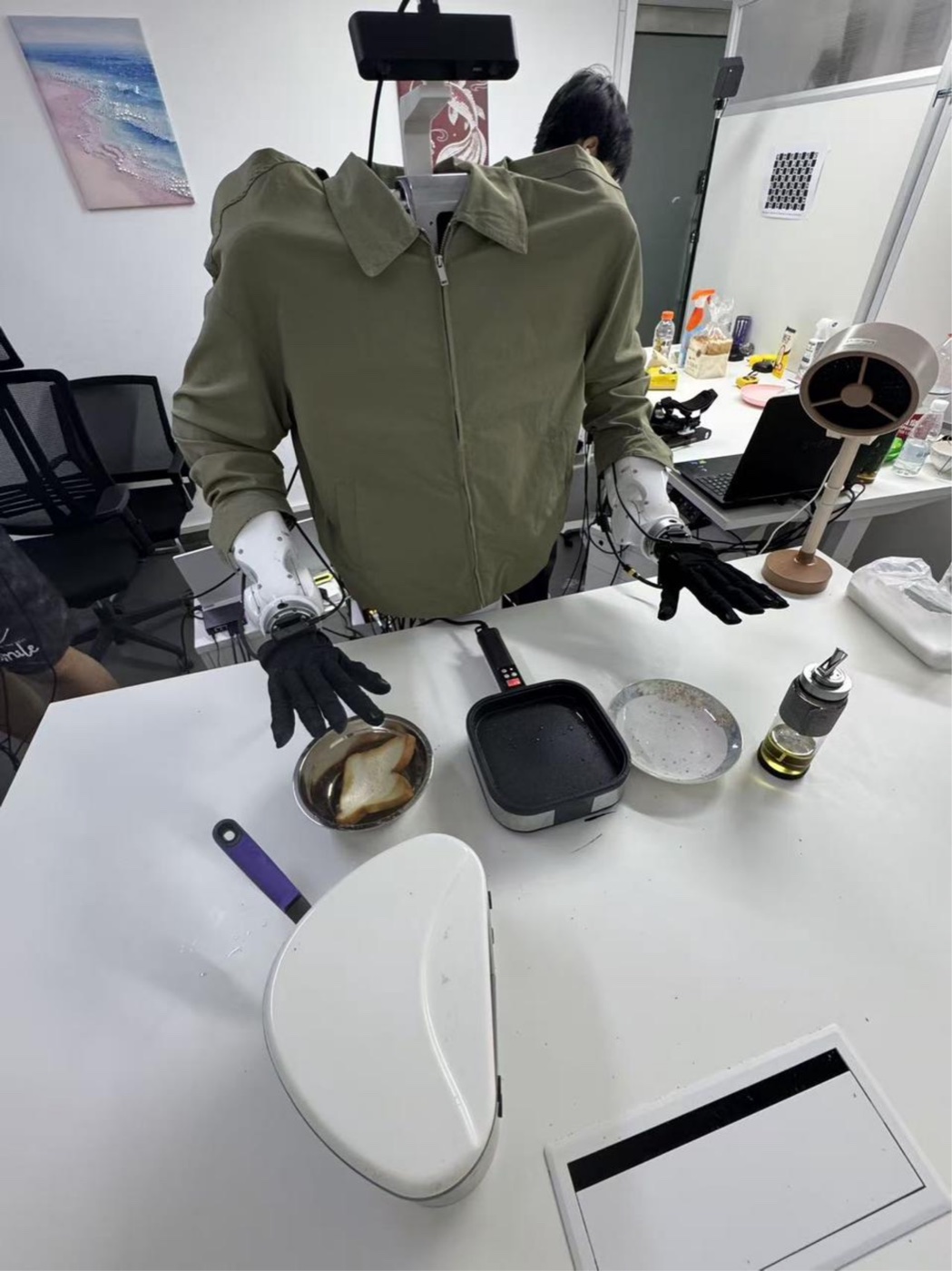
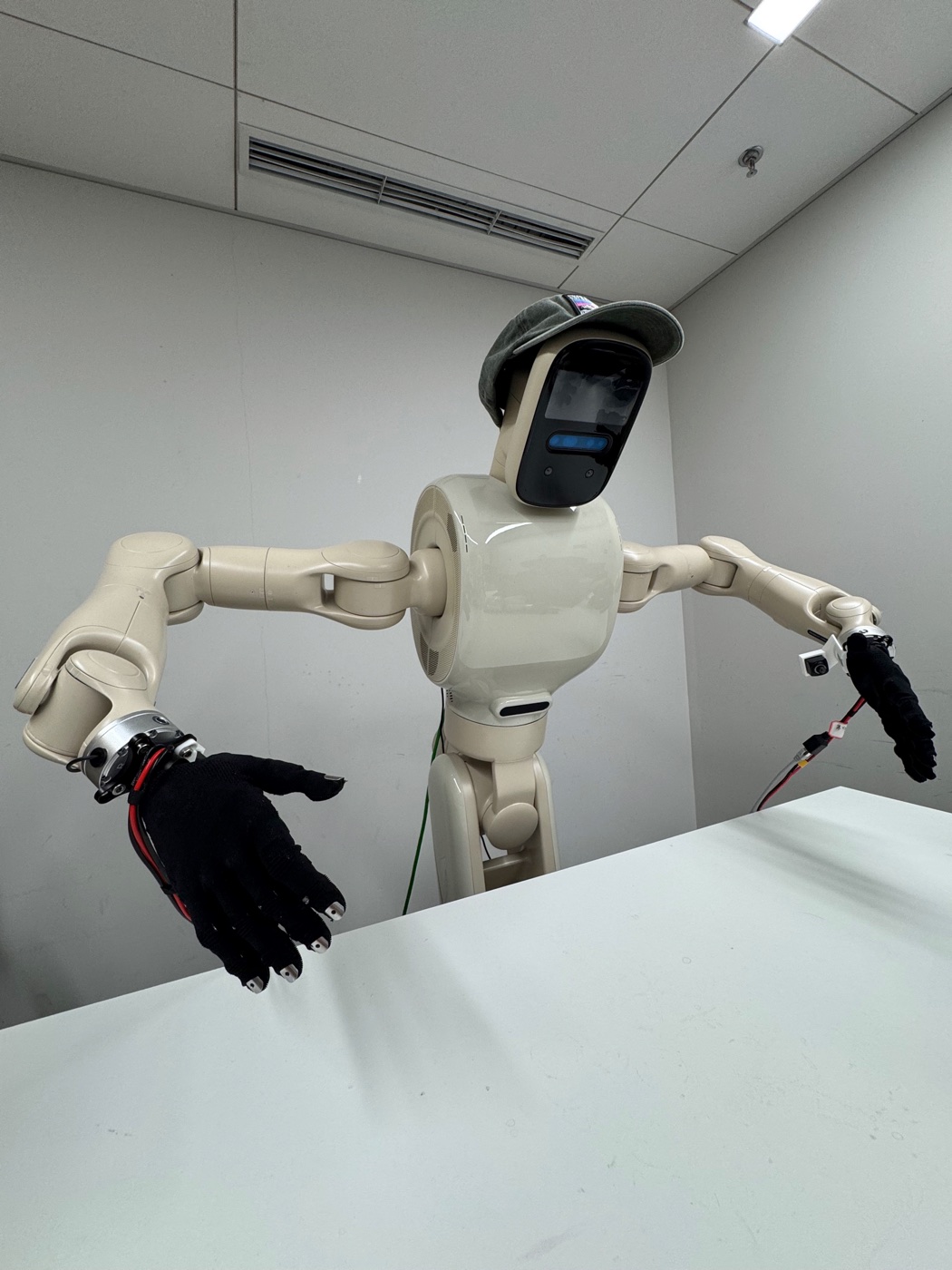
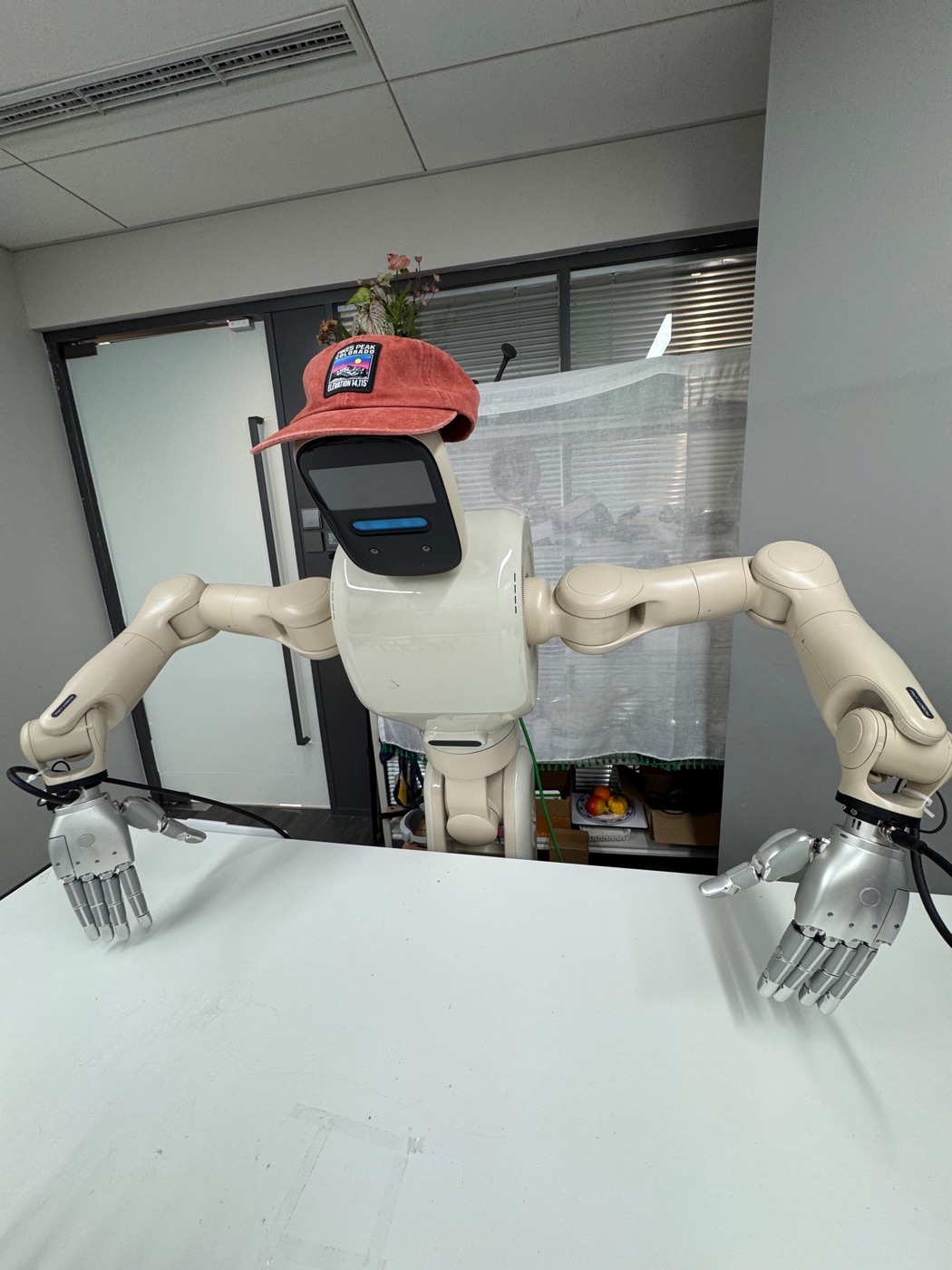
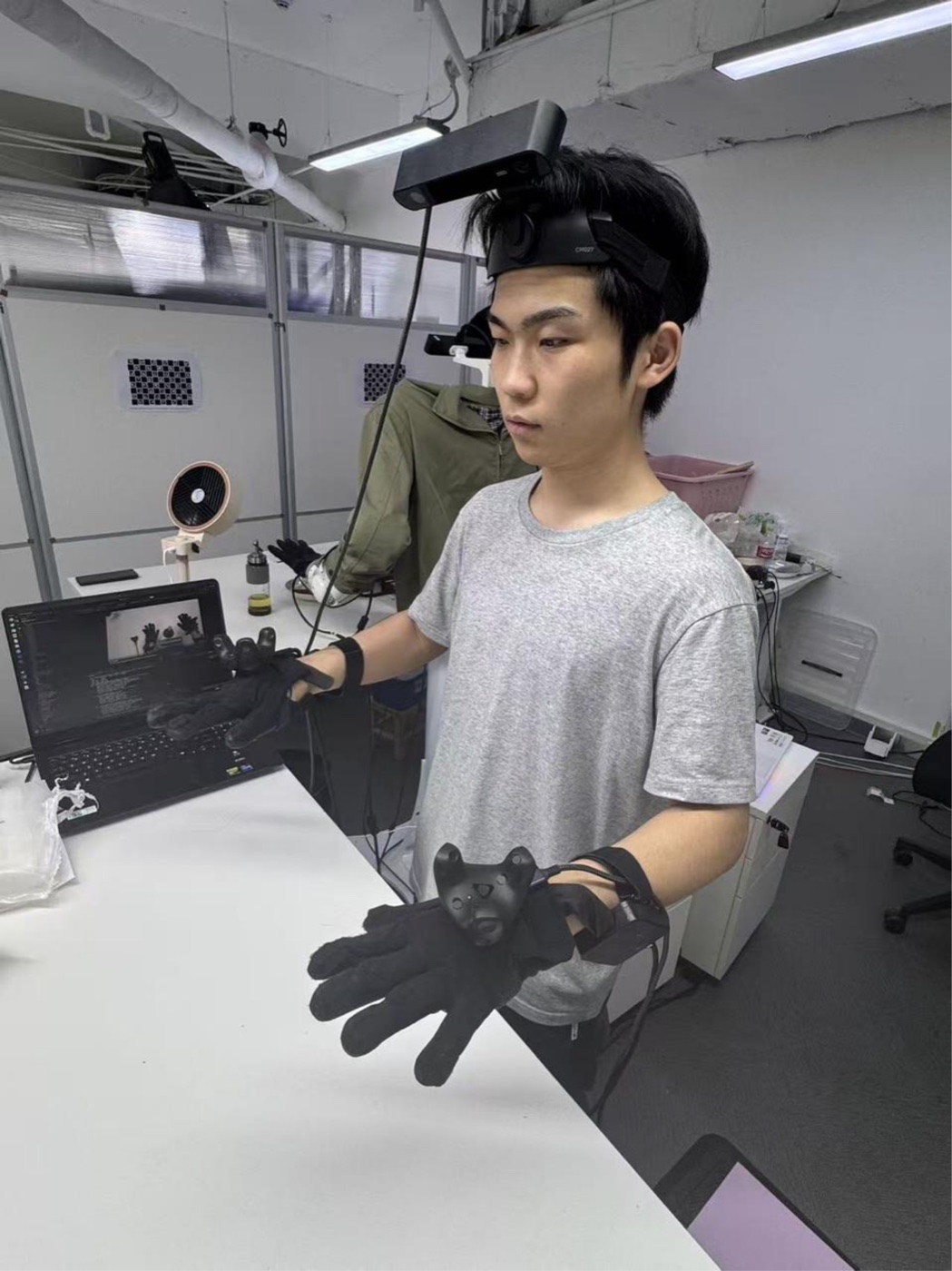
Three bimanual robot configurations are used for data collection and post-training. The separate human-robot alignment collection uses Wuji Human Gloves and does not command a robot.
Team
Partners
WuJi · Sharpa · Tianji
Ropedia · EgoScale · LightWheel · JD-Group · CyberOrigin
arXiv preprint: Motus2: A Self-Evolving General World Model for Dexterous Manipulation
@misc{bi2026motus2,
  title  = {Motus2: A Self-Evolving General World Model for Dexterous Manipulation},
  author = {Hongzhe Bi and Zihao Zhou and Yihang Tang and Jingrui Pang and
            Shuhe Huang and Haitian Liu and Runqing Wang and Shuai Huang and
            Yichen Wang and Yiming Cheng and Ruowen Zhao and Zhenghua Li and
            Hengkai Tan and Xiaolong Liu and Jinhui Wan and Jiabao Liu and Min Zhao and
            Fan Bao and Jun Zhu},
  year   = {2026},
  eprint = {2608.30237},
  archivePrefix = {arXiv},
  primaryClass  = {cs.RO},
  url    = {https://arxiv.org/abs/2608.30237}
}